

The Science of Spring Grass Recovery in April and May
Have you ever wondered how your lawn recovers after winter?
As temperatures rise in April and May, your turf starts coming back to life - roots wake up again and spring grass growth begins.
Understanding this process can completely change the way you approach lawn care. Rather than simply following a list of tasks, you can begin to see how and why your grass responds to different conditions at this time of year.
This is not a step-by-step guide, but an insight into the science behind your turf, from the spring flush and natural self-repair to the ideal conditions for grass seed germination.
What Happens Underground?
To give your lawn the best care this spring, you need to know the answer to one key question: when does grass start growing?
Many people look at the calendar and assume early spring is the start of the growing season. However, it is temperature, not the date, that controls when your grass wakes up from dormancy.
In the UK, most lawns are made up of cool-season grasses due to the cooler climate and high rainfall. These grasses only start growing again when temperatures stay consistently at 7°C or above. At this point, the soil is warm enough for growth to begin.
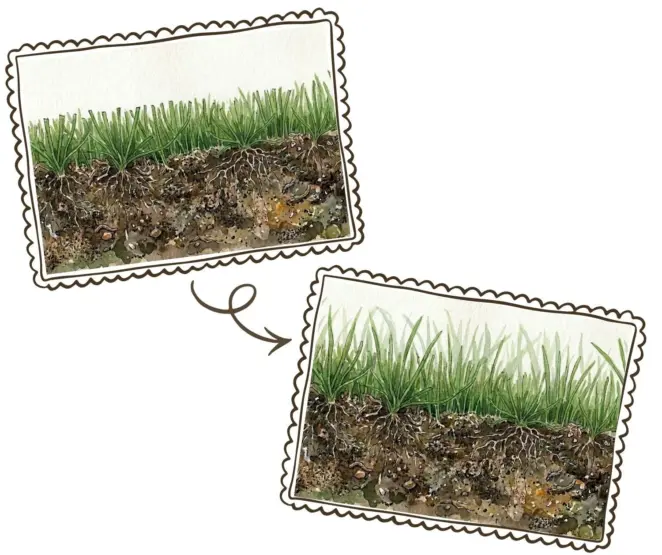
When this happens, the roots wake up and start taking in water and nutrients again. The lawn then begins to grow. It also starts producing chlorophyll, which is needed for photosynthesis and gives grass its rich green colour.
What Is 'Spring Flush'?
Once the grass comes out of its dormant phase and the days get longer and warmer, a process landscapers call the ‘spring flush’ occurs.
A spring flush is basically a rapid period of spring grass growth. As light levels increase, the grass produces more energy through photosynthesis. This causes it to grow quickly and deepen in colour, often over a short period of time. This strong burst of growth can quickly make your lawn look untidy if it is not managed properly. During this time, it is important to mow your lawn regularly and water it during dry spells if needed.
There is no exact start date for the spring flush, but it usually becomes most noticeable between April and May. However, this depends on local temperatures and weather conditions. For example, lawns in the North of Scotland may experience it later than those in the South of England due to cooler temperatures.
Self-Repairing Turf
Have you ever wondered how does grass repair itself after any damage that winter may have caused?
Certain grass species, such as the strong creeping red fescue and slender creeping red fescue used in our turf products, have a natural ability to spread and repair any thinner or bare areas of your lawn without any human intervention. This is due to their creeping growth habit that allows them to spread horizontally across the ground through rhizomes. As they spread, they produce new shoots and roots at different points of your lawn along the way. Over time, this allows the grass to gradually fill in gaps and create a thicker, more even surface.
However, not all turf is made up of these grass varieties. If you can see that your lawn is visibly struggling with bare patches, it may be best to overseed it and give it the boost it needs for the summer.
Why Seed Loves April Showers
Whether you’re overseeding an existing lawn or starting from scratch, April and May offer some of the best conditions for grass seed germination.
At this time of year, rising soil temperatures and increased sunlight help activate the seed and start the early stages of growth.
Spring also brings more regular rainfall, often called ‘April showers’. This helps keep the soil evenly moist. As the seed absorbs moisture, it swells and breaks down its outer coating. This allows roots and shoots to form.
While additional watering may still be needed during any dry spells, spring conditions generally reduce how often this is required. If the soil is not moist enough, the whole germination process can stop, and the seed may even die.
This combination of warm soil and reliable moisture means seeds are far more likely to establish evenly in spring compared to colder months, when growth is limited, or summer, when the soil can dry out too quickly.
Creating the Perfect Germination Bed
Understanding the biology of grass seed germination is very important when choosing the right timing to scatter your seeds, but there are also other things that you can do to improve germination rates.
One of them is creating the perfect germination bed. In nature, seeds grow best in loose, nutrient-rich soil that holds moisture and keeps them in contact with the ground.
You can recreate this by adding some high-quality topsoil, such as our Enriched Topsoil, when sowing your seeds. Aim to spread around 2-3 kilograms per square metre. This helps improve seed-to-soil contact, which is essential for germination, while also improving soil structure and adding nutrients.
You can then spread your grass seed of choice. We recommend our Rye Gold Lawn Grass Seed as it’s perfect for gardens with lots of foot traffic, or for families with children and pets. It also ensures your lawn will stay in great condition with very little work.
How Gardening Can Support the Grass Biology
If you want to undertake a lawn restoration in spring, you need to understand the science of lawn care.
As the grass begins to grow again, one of the most effective ways to support it is through scarifying and aerating. Scarification removes excess thatch. A small amount can be beneficial, but too much of it can create a layer that prevents air, water, and nutrients from reaching the roots. Aeration, on the other hand, loosens any compacted soil and provides your lawn’s roots with easier access to air, water, and nutrients. As a result, you will end up with a stronger, thicker lawn that has better pest and disease resistance, along with less weeds and moss.
Applying a spring fertiliser is another great way to support rapidly growing grass. The specialised spring formula is high in nitrogen, promoting vibrant, dense foliage, while other nutrients encourage deeper roots, just in time for summer.
April and May are the key months for your lawn, allowing it to recover from any winter damage and prepare for the hot summer.
The longer days, warm soil, and spring showers create the perfect conditions for the grass to grow and for new seeds to germinate. Different gardening practices, such as scarifying, aerating, and fertilising your lawn, can further improve your lawn’s health and support its growth and repair during this time.
