

How Real Lawn & Topsoil Prevent Garden Flooding
Are you wondering how to stop your garden flooding?
The UK’s weather is slowly changing. Summers are becoming hotter, while winters are becoming wetter. As a result, many people now find their outdoor spaces more susceptible to flooding.
Choosing real over artificial turf in your garden is one of the easiest ways to help reduce flooding and improve your garden’s drainage. Established grass roots create channels in the soil. These support good soil structure and allow rainwater to soak deeper into the ground. Applying a quality top-dressing takes this a step further, preventing water from pooling on the surface.
The Rising Problem of Garden Flooding
Have you noticed your garden flooding more often over the past couple of years?
This is not just a coincidence.
According to the Met Office, ‘The winter half-year from October to March was 3% wetter during 2016–2025 than the 1991–2020 average, and 13% wetter than 1961–1990’.
In simple terms, UK winters are seeing heavier, more intense downpours. As a result, many gardens are struggling to cope with the extra water, leading to flooding.
Flooding is bad for your garden for several reasons. It can quickly turn your garden into an unusable mud bath, making it much harder to access certain areas. It can also wash vital nutrients and minerals out of the soil. This can leave your plants struggling and increase the risk of fungal diseases.
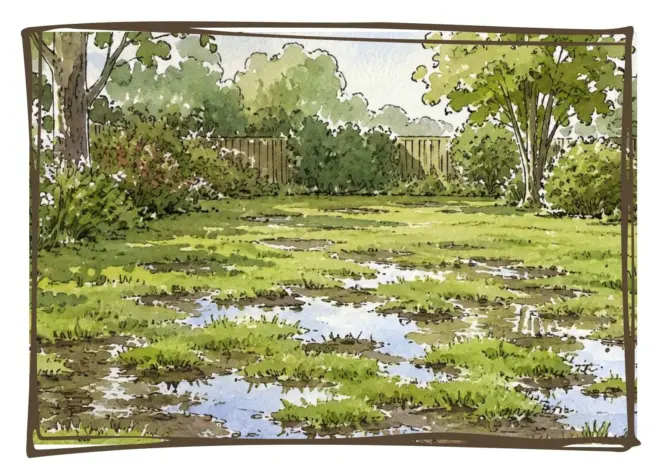
The effects can extend to your home, too. If water reaches your property, it can damage building materials and contribute to damp and mould. This can create an unhealthy living environment.
The Danger of Artificial Turf and Paving
You may be wondering: does artificial grass cause garden flooding?
Southampton City Council states that ‘there has been a growing trend for artificial lawns despite several studies showing that artificial lawns have poor drainage and can increase the risk of surface water flooding’.
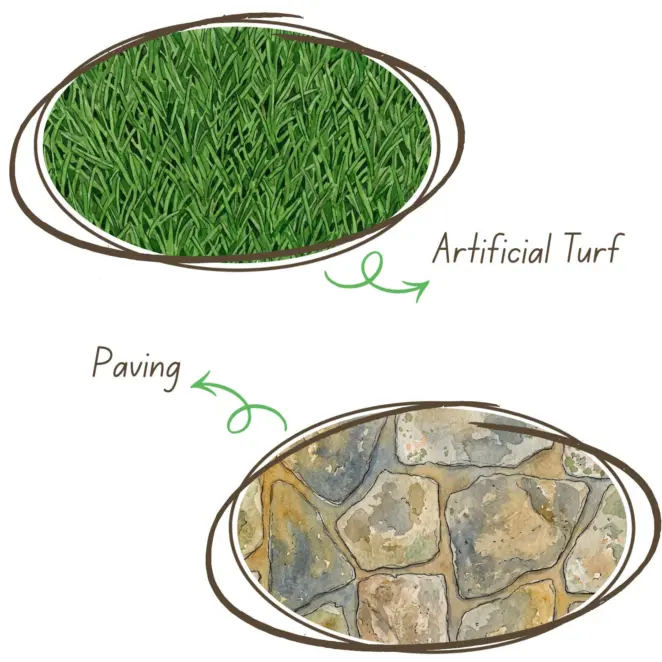
This is because artificial turf can sometimes act as a waterproof barrier, preventing the water from soaking into the ground. Artificial grass is also worse for wildlife and has a limited lifespan. Eventually, it ends up in a landfill.
Using paving in your garden poses a similar problem. Paving is an impermeable surface, meaning it does not allow water to travel through it.
As a result, having too much paving or artificial turf affects your garden’s ability to absorb rainwater. This can increase rainwater runoff by as much as 50%, contributing to flooding as water flows across these hard surfaces and collects in lower areas or near your home.
Even if this does not affect your garden directly, rainwater still has to go somewhere. Excess water can flow into street drains, which cannot always cope during heavy downpours. As a result, water could build up on other people’s driveways and potentially flood their homes.
How Real Grass Acts as a Natural Sponge
Deep Root Networks
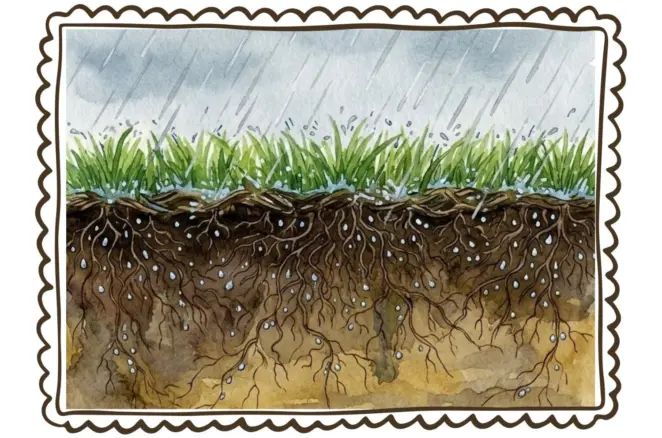
If you’re wondering how real grass helps to absorb water in your garden, the deep root system is the answer.
As your turf grows, it develops a root system that creates channels and supports good soil structure. These channels then help rainwater to soak deep into the soil, rather than running off the surface immediately. At the same time, the soil can store more water as the roots and organic matter help to create more spaces for it within the soil.
The dense root network also anchors the soil in place, preventing it from washing away during heavy rain and losing nutrients.
To learn more, visit our ‘Benefits of Natural Turf’ blog.
The Power of Quality Topsoil
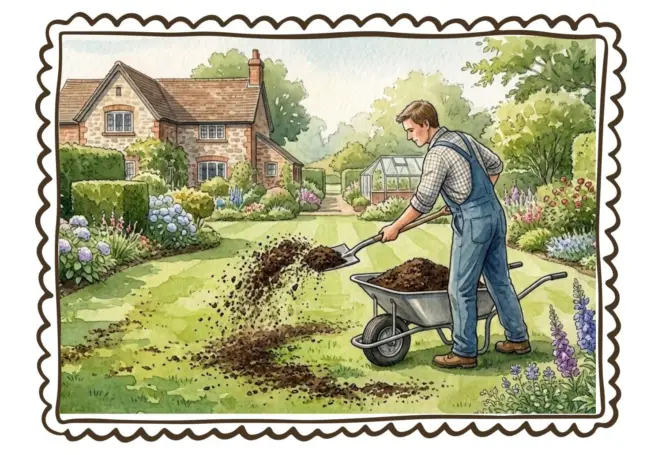
While using topsoil for drainage on its own is not sufficient, a good-quality product, like our Enriched Topsoil, can be used to create a top-dressing mix. When applied annually, this can help to improve the structure of your soil over time, creating better drainage and airflow. This can help reduce surface runoff and lower the risk of garden flooding even further.
To make top dressing, simply mix three parts sharp sand, six parts topsoil, and one part peat-free compost. Then, use the back of a metal rake to work the dressing in, aiming to apply around 2-4 kg of the mixture per square metre.
The best time to top dress a lawn is in spring or autumn, when the grass is actively growing. This allows the grass to grow through the dressing and recover more easily from the treatment.
To learn more, make sure to visit our ‘What Does Topsoil Do? Why Your Lawn Needs It’ blog.
Future-Proof Your Garden Against the Rain
With the UK winters getting wetter, many gardens are at a higher risk of flooding.
This is where investing in real turf can really make a difference. The deep roots create multiple channels in the soil, allowing the water to drain away properly. Planted soil can also hold more water and is less susceptible to soil erosion.
In comparison, paving and artificial grass can sometimes create a waterproof barrier that prevents water from soaking into the ground. This increases surface runoff and contributes to flooding.
Don’t wait! Explore our full range of turf products and future-proof your garden against the rain.
